Fast markets
Five-minute crypto markets, decided by a price anyone can check.
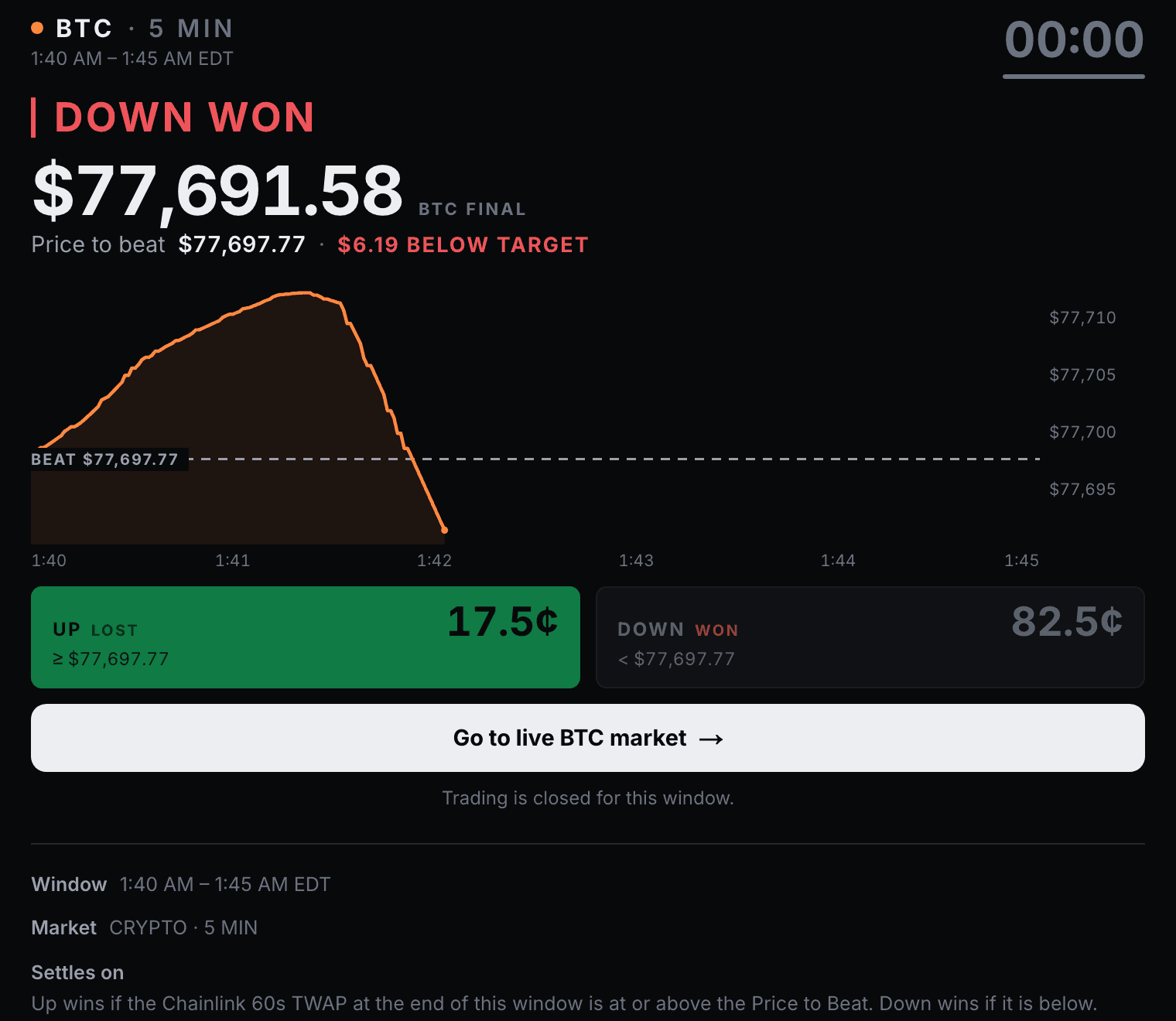
Recurring up-or-down windows on Bitcoin, Ethereum and Solana. Each one runs for exactly 5 minutes against a price to beat captured at the open, resolves on a published Chainlink 60-second reference price, and hands the player straight into the next window.
The contract
One question, one window, one number.
A five-minute market asks a single thing: at the end of this window, is the asset above or below where it started? The reference price at the open is the price to beat, it is printed on the surface throughout, and the contract is decided by reading the same published reference again at the close.
Windows run continuously for BTC, ETH, SOL, one after another with no gap. As one closes the next is already open, priced and streaming, so a player who wants another go waits for nothing to load and never has to go and find the new contract.
The session shape is the reason an operator looks at this product: a complete decision cycle in five minutes, with a result the player can verify against a public number rather than take on trust.
The mechanism
The life of one window.
- 01
The window opens on the clock
Windows sit on an exact five-minute grid aligned to the wall clock, and a window is identified by its own start time. Nothing has to go looking for one: the current window, the next and the one after it are arithmetic, which is what lets a countdown be trusted and what makes a rollover a pointer move rather than a fetch. - 02
The price to beat is captured, and then never moves
The reference price at the open becomes the price to beat for that window. Up wins if the reference at the close is at or above it. Down wins if it is below. Locking it at the open is what makes the question answerable: a strike that drifted during the window would leave a player unable to say what they had backed. - 03
Both legs trade, against a line drawn from the settlement feed
Up and Down are priced in cents and move as the market moves. The chart beside them is drawn from the same published feed that decides the contract, not from a faster spot price that would disagree with it at the worst possible moment. Every plotted point is a real observation, nothing is interpolated to fill a gap, and a figure the pipeline can no longer vouch for is removed rather than left on screen looking current. - 04
Trading stops at the close, with nothing added on
Two independent statements of when the window ends are consulted, the ingested close and the window carried in the contract's own identifier, and the earlier of the two binds. The venue's own signal can only close it sooner. That strictness is the point: the number that decides the contract is published within seconds of the close, so a market left quotable half a minute too long is a decided outcome on sale. - 05
The venue publishes the outcome, and settlement is reported to you
Between the close and the published result the market is settling, which is a real state and is shown as one rather than as a price or a result. Parity never decides the outcome itself. Once it is published, the window becomes a settlement record delivered to your webhook endpoint on the same path as every other market, safe to apply twice without paying a customer twice.
The price a player watches is the price that settles the contract.
The obvious way to show a live crypto price is to pull a public spot feed. On a contract this short that is a trap: the number on screen and the number that settles will disagree, usually by very little and occasionally by enough to decide the outcome. A player who watches a price cross the line and then loses has a complaint nobody can answer.
So the surface streams the authoritative Chainlink 60-second reference itself, the same one the contract resolves against. A five-minute window is also judged on much tighter freshness bands than the rest of the catalogue, because an observation that would still be current elsewhere is already several percent of this contract's entire life.
How 5-minute Bitcoin prediction markets work covers the same ground for a technical reader.
The line rule
A market too close to decided is not a wager.
If either leg is executable above 95 cents, the whole line stops being wagerable. Not the expensive side, the line: a contract whose Up leg is offered at 97 cents is one whose Down leg is offered at 3 cents, and both are the same statement about the same market.
The reason is arithmetic rather than taste. The platform fee comes off the top of the stake, so the break-even price is below a dollar, and the approach to it is not gentle. A player who is right at 99 cents is a player who has lost money.
- At 95 cents
- Available. A $25 wager buys 26.00 contracts and returns $26.00 if it is right.
- At 96 cents
- Refused. The same $25 would return $25.72, a profit of 72 cents.
- At 98 cents
- Refused. The same $25 would return $25.20.
- At 99 cents
- Refused. The same $25 would return $24.94, so a correct call loses money.
Figures at the default fee rate of 120 basis points, which is taken from the stake before contracts are bought. The rule is applied to the executable price on the live book, recomputed on every quote and every order, so a line that runs hot and comes back is simply available again.
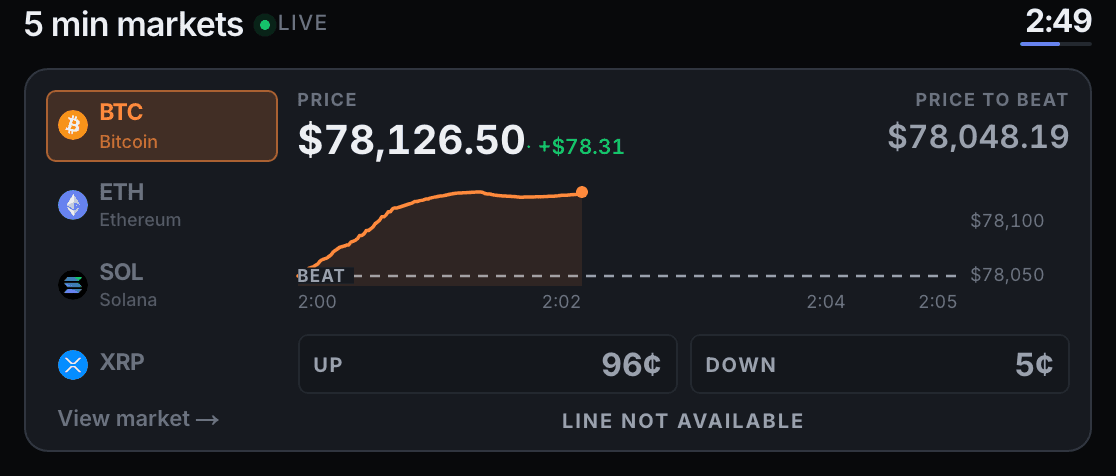
Being right has to be worth something. A line where it is not is refused on both sides rather than sold to whoever reaches it first.
Your side
What it takes to run it.
The schedule, the reference feed, the pricing, the availability rule, the surface and the settlement are Parity's. What follows is the whole of the other side, and none of it is specific to the fast product.
- A session endpoint
- One server-to-server call maps a signed-in customer to a Parity session and returns a browser-safe token. Parity never authenticates your players and never sees their credentials. The same endpoint serves the whole catalogue, so the fast markets add nothing to it.
- The frame, and a message listener
- The surface renders inside your product on your brand, with the five-minute markets as one section of it. Your team writes a message listener, not a countdown, a chart or a ticket. If you would rather build the front end yourself, the same account can drive the API directly.
- Your ledger, and only your ledger
- Parity returns the exact amounts to reserve, debit, release and credit, and you apply them to the balance you already hold. There is no transfer step and no second balance. The casino operator's version of this argument goes through the wallet question in full.
- The limits, and who sees it at all
- Stake sizes, session controls, responsible-gaming rules and eligibility stay on your side of the line, because they belong to the account and the licence rather than to the market. A product that recurs every five minutes is one to set those deliberately rather than by default.
- A webhook endpoint
- Settlement records arrive as events rather than being polled for, and two reconciliation endpoints exist for checking your books against ours. Windows resolve continuously, so this is the piece that carries the volume.
Where the final allocation of KYC, custody and regulatory responsibility falls is a commercial and legal question per jurisdiction, and this page does not settle it. The architecture, including what crosses the boundary and what never does, is on embedded prediction markets, and the endpoints are in the developer docs.
Read next
Crypto markets
Crypto prediction markets
The wider category these windows sit inside, and what offering crypto markets does and does not put on an operator's books.
Read moreGuide
How 5-minute Bitcoin prediction markets work
Scheduling, the price to beat, the 60-second reference price, and why the feed on screen has to be the feed that settles.
Read morePlatform
What you get
Catalogue, priced execution, continuously marked positions and settlement reported to your ledger, from one integration.
Read moreRun the five-minute markets in your product.
Tell us where your players are and what your licence permits, and we will walk your team through the integration and the limits.